By Azalea Park Foundation Repair · Published 2026-09-27 · Last updated 2026-09-27
Sandy soil drains quickly after rain but loses fine particles through lateral water movement, which erodes the subgrade beneath concrete slabs faster than denser soils would. The 32807 zip code near Orlando Executive Airport is situated in an area where the subgrade soil can remain saturated longer than the surface suggests. Each rain event washes fine sand grains away from under slab edges, forming hidden voids that grow wider over time. Surface cracks on a runway can indicate significant voids forming directly beneath the slab. Settlement in Azalea Park's sandy soil moves faster than in clay-heavy areas of greater Orlando because sand particles have almost no cohesion to resist water movement. Early detection and professional inspection are the most reliable ways to prevent small voids from becoming full slab failures.
What makes Azalea Park's sandy soil different from other Orlando soils?
Azalea Park sits on a loose, fine-grained sandy soil that behaves very differently from the clay-heavy soils found in other parts of greater Orlando. Clay soils bind tightly together and resist water movement. Fine sandy soil doesn't.
How does grain size affect soil stability under heavy concrete?
Fine sand particles have low cohesion, meaning they don't stick to each other the way clay or loam does. Under a heavy concrete slab, that difference matters a great deal.
The 32807 zip code covers a relatively flat, low-lying section of Central Florida. That character contributes to the area's sandy, porous soil composition. According to Florida's sandy soil classification data, Central Florida's coastal plain deposits produce exactly this kind of fine, loosely packed material.
Sandy soil in this area has large pore spaces between grains. Water moves through those spaces quickly, in both directions: downward and sideways. Lateral water movement is the key difference from most other soil types. Water doesn't just drain straight down. It carries sand particles sideways, away from under slab edges, with every rain event.
Coarse sand or gravel resists this process better because larger particles are heavier and harder to move. Fine sand grains are light enough that even low-velocity water can pick them up and transport them. A subgrade made of fine sand loses material steadily, even when the surface looks dry and stable. We've walked plenty of slabs that looked perfectly fine on top while the ground underneath was quietly disappearing.
How does sandy soil cause concrete slabs to settle over time?
Sandy soil causes concrete slabs to settle because fine grains migrate away from the load-bearing zone under the slab, leaving hollow spaces the concrete then sinks into. The process is gradual at first, then accelerates as the void grows larger.
What is subgrade erosion and why does it happen under concrete?
Subgrade erosion is the removal of soil particles from directly beneath a concrete slab by moving water. The subgrade is the prepared soil layer that supports the slab from below. When water enters through a joint or crack, it picks up loose particles and carries them out through another opening. Each water event removes a small amount of material. Over many events, that removal adds up to a significant void.
Here is the erosion cycle that repeats under a runway slab in sandy soil:
- Rain event begins. Water flows across the runway surface and enters the subgrade through slab joints, cracks, or unsealed edges.
- Water moves under the slab. It travels laterally through the sandy subgrade, following the path of least resistance along the slab's underside.
- Sand migrates away from the load zone. Fine particles lift off the subgrade surface and travel with the moving water, exiting at slab edges or adjacent joints.
- A void forms. The space left by missing sand particles becomes a gap between the bottom of the slab and the remaining subgrade.
Unlike clay soils that swell back after a wet period, sandy soil doesn't refill the void on its own. Once fine sand particles are gone, the space stays empty. Runway slabs face extra risk because aircraft wheel loads concentrate heavy, repeated stress at the same slab joints and edges on every landing cycle. That repeated loading can pump water in and out of the subgrade, pulling more particles out with each cycle. The process moves slowly for a long time, and then one wet season it doesn't.
Why does a high water table make runway settlement worse in Azalea Park?
When the water table is elevated, the ground below a runway slab is already near saturation, so even moderate rain can quickly overwhelm the soil's ability to drain safely. When the zone between the surface and the water table is thin, incoming rainwater reaches the slab subgrade much faster than it would in a drier region.
What is soil bearing capacity and why does it matter for runways?
Bearing capacity is the maximum load a soil can support without shifting or failing. Dry or moist sandy soil has some bearing capacity. Saturated sandy soil has almost none.
When fine sand grains are fully surrounded by water, water takes on the job of supporting any applied load. But water doesn't compress. It moves. So the load from a concrete slab and the aircraft landing on it gets transferred to water pressure rather than solid soil contact. That pressure pushes water outward through the sand, carrying particles with it.
Prolonged saturation also weakens the friction between fine sand particles. Sand grains that were interlocked in a dry state slide past each other easily when wet. Lateral migration of particles happens faster during and after storm events precisely because that inter-grain friction is gone. The result is a subgrade that erodes more rapidly during wet seasons than comparable sandy soil in drier locations.
How quickly can voids form under a runway slab in sandy soil?
In Azalea Park's sandy soil, voids under a runway slab can begin forming relatively quickly, especially at slab joints and edges where water enters most easily. The timeline from first void to structurally dangerous void is shorter than many airport managers expect.
What factors speed up void formation under airport concrete?
Three main factors control how fast a void grows: rain frequency, traffic load on the slab, and the condition of joint sealant. Central Florida's rainy season brings sustained erosion pressure for several consecutive months each year. That's not a brief window you can check once and walk away from.
| Slower void formation | Faster void formation |
|---|---|
| Intact, well-sealed joints | Cracked or missing joint sealant |
| Light or infrequent traffic | Heavy or frequent aircraft traffic |
| Adequate perimeter drainage | Poor drainage, water pooling at edges |
Voids can grow considerably within a single rainy season if no intervention takes place. The concrete slab above the void doesn't sink immediately. The slab bridges the gap using its own structural strength. But concrete slabs have limits. As the void widens, the unsupported span increases until the slab begins to flex, crack, and eventually drop.
A slab that looks structurally sound, with only minor surface wear, can have a large void directly beneath it. Waiting for visible surface distress before scheduling an inspection means waiting until the problem is already advanced.
What surface signs warn you that runway settlement is already happening?
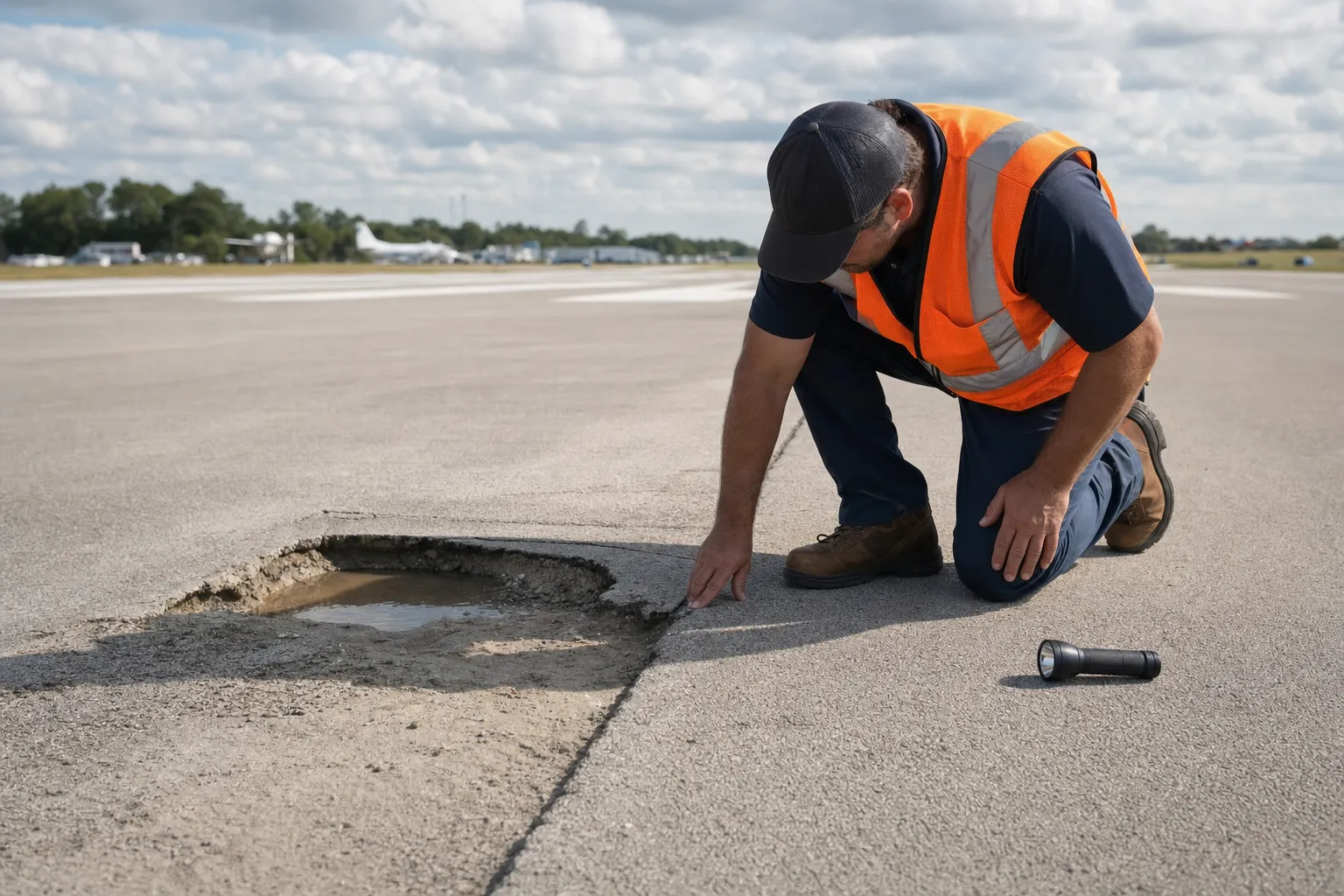
The most common surface warning signs of runway settlement are visible cracks at slab joints, uneven slab edges, and water pooling in areas that used to drain cleanly. Spotting these signs early gives you the best chance of a repair that doesn't require full slab replacement.
Why is a small surface crack more serious on a runway than on a sidewalk?
A runway crack under repeated aircraft wheel loads can grow significantly and worsen more quickly than a crack under lighter, less frequent pedestrian traffic. Aircraft landing gear applies focused, heavy loads at joint locations where cracks form, which can widen the crack and allow more water into the subgrade below.
Keep an eye out for these five warning signs on any runway or taxiway surface:
- Hairline cracks parallel to slab joints. These run along the joint line and signal that the subgrade below has shifted or lost support. Often the first visible clue.
- A step or lip between adjacent slab panels. Called a fault, this step means one slab has dropped lower than its neighbor. Even a quarter-inch fault is significant on a runway surface.
- Water pooling where drainage used to be adequate. Standing water in a spot that previously drained signals a change in slab elevation, even a very small one.
- Slab rocking under traffic. A slight movement or bounce when a vehicle or aircraft passes over a joint means the void beneath is large enough to allow the slab to flex.
- Corner cracking at slab intersections. Cracks radiating from the corners of slab panels indicate that corner support is gone, a direct sign of subgrade loss at that location.
If you're seeing more than one of these at the same panel, don't wait to see if things stabilize. In sandy soil, they won't.
How does heavy rain speed up subgrade erosion under Azalea Park runways?
Heavy rain speeds up subgrade erosion by forcing large volumes of water under slab joints in a short time, giving the water enough energy to carry fine sand particles away from the load zone. The intensity of the event matters as much as the total rainfall amount.
Florida's intense summer thunderstorms deliver rainfall at rates that can overwhelm even well-designed drainage systems. Water that can't drain fast enough across the runway surface builds up at low points and slab joints, then pushes horizontally under slab edges. The pressure behind that water column is what gives it the energy to move fine sand particles.
After rain stops, the sandy soil surface can appear dry within hours. That surface dryness is misleading. At the subgrade level, just a few inches below the slab bottom, the soil can stay saturated for days. During those days, slow lateral water movement continues to carry fine particles away from the load zone, even with no rain falling.
When we're assessing runway conditions in Azalea Park, we account for that delayed subgrade saturation when we schedule inspections. An inspection done the morning after a storm may show a wet subgrade. Done three days later, it may show a dry surface over a still-saturated subgrade with a growing void.
What happens to sandy soil between rain events, does it recover on its own?
Sandy soil does not recover lost fine particles through natural recompaction. When fine sand grains wash out from under a slab edge, those grains travel to a drain, a ditch, or a lower section of the subgrade. They don't wash back under the slab when conditions dry out. The void left behind stays empty until we fill it with a structural grout or similar material. Sandy soil has no self-correcting mechanism. The material is gone and the void stays until someone addresses it.
When should you call a professional for runway leveling in sandy soil?
You should call a professional as soon as you notice any step between slab panels, visible joint cracking, or water pooling where drainage used to be adequate. Waiting for those signs to get worse before acting is a common mistake in sandy soil environments, and it's one that tends to turn a manageable repair into a much larger one.
What does a runway leveling inspection involve in Azalea Park?
A professional inspection for runway settlement typically starts with a visual survey of all slab joints, panel edges, and drainage outlets. The inspector notes any faults, cracks, or pooling areas on a site diagram.
A common next step is non-destructive subsurface mapping, often using ground-penetrating radar (GPR). GPR sends a signal through the concrete and reads the reflection from whatever is beneath. A solid subgrade produces a clear, consistent reflection. A void produces an irregular or hollow reflection pattern. GPR can help identify void locations and estimate void dimensions without cutting or removing any concrete.
We'd rather you not wait to "see if it grows" in sandy soil. Voids can expand significantly between inspection cycles without producing any new visible surface change. A slab that looked stable in a visual check six weeks ago may have a void twice as wide today.
Early-stage voids are commonly addressed with slab lifting and void filling. A contractor drills small holes through the slab, injects a structural fill material under pressure, and lifts the slab back to its original elevation. Generally less disruptive than full slab removal and replacement.
Sandy soil repairs also require correction of the root cause. Drainage improvements and joint resealing typically need to accompany the void fill, or the same erosion process can restart. Addressing only the void without fixing water entry points can lead to repeat settlement at the same location. We see this happen when the repair focuses on the symptom and not the cause.
The Bottom Line
Azalea Park's fine sandy soil erodes quickly under concrete slabs because water moves through it fast and carries particles away from the load-bearing zone. Elevated water table conditions and Florida's heavy rain season combine to make that process happen faster in the 32807 zip code than in many other parts of Florida. Surface cracks are often the last visible sign of a problem that started weeks or months earlier below grade. To learn what leveling options are available for Central Florida's sandy soil conditions, visit our page on airport runway leveling in Azalea Park.