
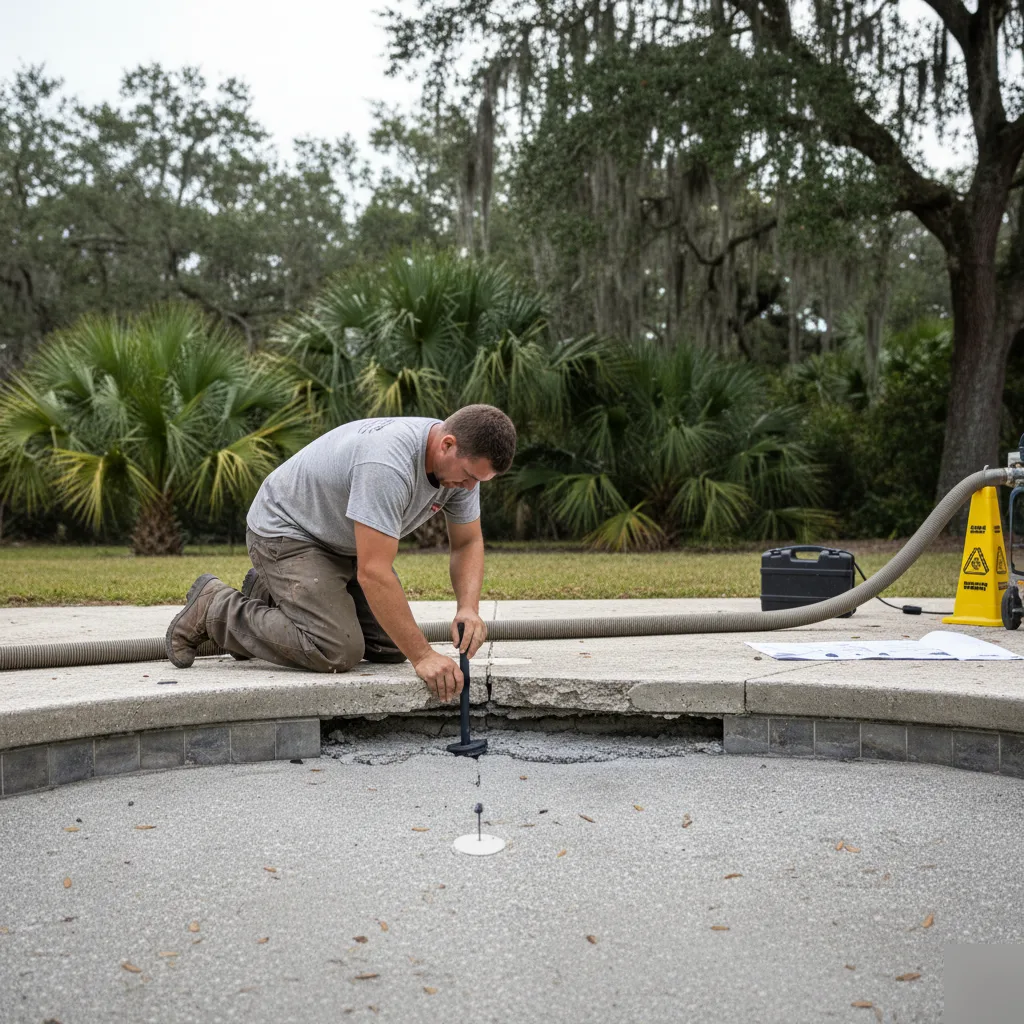
Why Pool Decks Sink in Central Florida's Sandy Soil
It's a quiet discovery, especially when you work with a professional residential foundation repair contractor. You step outside for the morning coffee, and suddenly the concrete around your pool looks off. A slab that used to be flush with the coping now sags. A visible gap has opened where the coping meets the slab. It looks bad, but more importantly, it tells you that what's happening beneath your feet is not going to correct itself.
Azalea Park, FL, is no different, soil science says. Central Florida sits on a foundation of fine, loosely bound sand and peat-like organic materials that behaves completely differently than the heavy clay soils of other U.S. regions. When heavy Florida rain soaks into this loose sand layer, it becomes mobile and settles unevenly. The process accelerates in the spring and summer when dry periods pull moisture from the ground and voids are created under the pool slab. Your Azalea Park pool slab has only one direction to move: down.
In Azalea Park, we see this issue constantly along the Lake Underhill Road corridor and in the neighborhoods around Lake Barton. Areas around water bodies tend to have very loose soil that is highly porous. This increases the rate of erosion under your concrete slab, especially in areas where pools are constantly exposed to overspray and pool return water.
Sinking around your pool can accelerate rapidly when one of these four events occurs:
- Leak from backwash line that erodes soil beneath deck
- Poor compaction from original installation
- Tree roots draining water from sub-soil
- Florida heavy rains washing finer sand layers below concrete slab
According to the University of Florida's Soil and Water Sciences Department, the vast majority of residential housing in Orange County is built on fine sand which is poorly-graded. It is the technical way of telling homeowners the ground under the slab is meant to shift.
The unfortunate thing is that most homeowners in Azalea Park do not recognize that sinking is typically a gradual process. It is not sudden. It might start at ¼" then become ½" inches over time. If you have not been aware of any of this happening for some time, the sink can be several inches and will create water pooling issues and tripping hazards. The longer you delay, the wider the affected area will become. An issue that started out with one panel might grow and become three to four panels creating an unsafe and uncomfortable surface around the pool.
The good news is that we can fix this issue with pool deck leveling without having to tear out the concrete slab. However, it is important to understand why the issue exists, as the longevity of the repair is heavily dependent upon addressing the root cause.
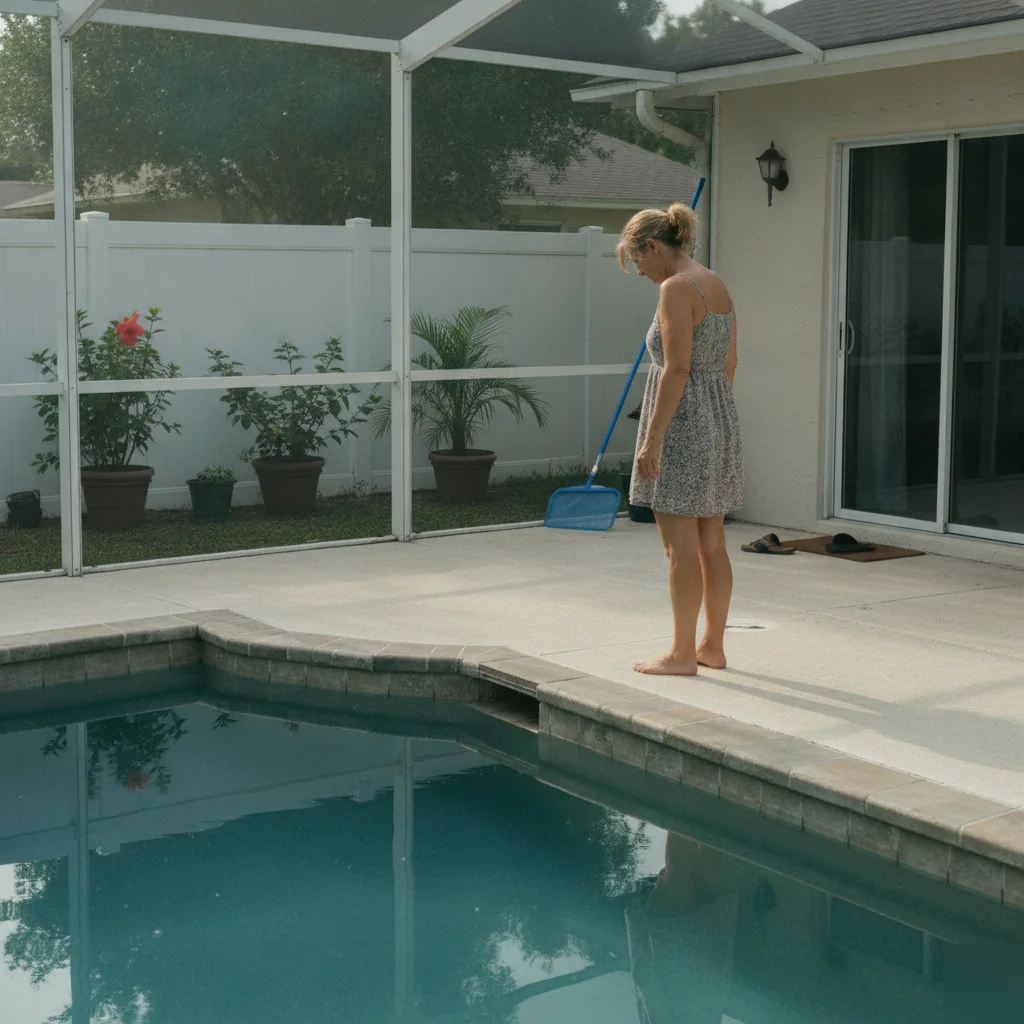
Warning Signs Your Pool Deck Needs Attention Now
That lip at the seam between two slabs? It was not there 1 year ago. We hear this constantly from homeowners in Azalea Park. You can tell something is not right around the pool but you're not sure if it is an issue yet.
It is an issue.
Pool deck leveling issues do not resolve themselves. They actually become increasingly bad. Florida's sandy soils are constantly moving, and water tables near places like Lake Underhill Road keep the soils under your pool deck slabs in motion. When you realize something has changed, the soil has often already moved. Here's what to look for:
- Joints between concrete slabs which are uneven by even 1/4 of an inch, creating a tripping hazard near your pool
- Cracks forming in concrete, that worsen after heavy rains
- Water ponding in areas which previously didn't pond
- A noticeable gap between the coping and the adjacent deck
- Slabs which wobble or rock if stepped upon near edges of slab
In other words, we see the same thing underneath: voids. The soil eroded, or compacted, the slab was no longer supported by it, and gravity took it from there. That wobble you feel near the end of a deep deck means the deck is not being supported by soil.
Also, many people miss that the first sign of problem is often with water drainage. Standing water after a storm means your pool deck has settled. Water that sits will work under nearby slabs and accelerate the erosion of soil. The problem causes another.
Recently, we've had calls from people in the 32807 zip code who told us "we have a few cracking slabs". Once the entire pool deck was inspected, they often had three or four slabs which had started to sink. The cracking slabs were just the most obvious symptom. Identifying these early will mean that repairs can be more contained, there will be less impact on use of the pool deck for your family, and your safety will be maintained immediately.
Don't know if it is a problem? It is really common not to know. We get a call almost every time from someone who says "I don't think I should be bothered with this." And the answer is almost always "yes, you should".
Leveling versus Replacement: What Most Azalea Park Homeowners Actually Need
Here's a question we get almost every time our phones ring. "Can I just tear out the pool deck and replace it?" The answer is "no".
Pools and pool decks can be demolished, which makes it sound like the proper course. The problem is that the demolition of a pool deck is very intrusive — heavy equipment around your pool shell, days of demolition, and the possibility of damaging plumbing, the pool beam, and the pool surface itself. New concrete then has to be poured and needs to set, which in Azalea Park's humidity can take longer than you may want. This process could go on for weeks, during which time your pool cannot be used.
Concrete leveling is different. You are not tearing concrete up to replace it, but rather lifting it to where it should be. Most of the time the concrete itself is perfectly fine; the problem is actually the soil that was supporting it. The soil beneath concrete around pools near Lake Underhill Road is constantly moving in our rainy season, and it is this that will move concrete out of position.
Why tear out a perfectly usable slab when we can raise it back up instead? These are the times leveling is a viable solution:
- When the slab has sunk down, but not so far as to be fractured into individual pieces.
- When the sinking of the pool deck causes puddles of water to form next to the swimming pool or drain toward the house.
- When the drop has created trip hazards between expansion joints or between slabs meeting in the middle of a pool deck.
- When the surface has not degraded to the point where it has spalled or cracked into many pieces.
The only time we recommend replacing rather than leveling a slab is if it has become so badly deteriorated that it can't function. That means slabs that have lost major portions of their thickness, where the rebar shows, or slabs that have split up into pieces too small to pry up. That's not common. Most pool decks in Azalea Park are constructed so thick that they could remain functional even decades after installation. Once raised back up, they will continue to support your deck, even if the surface of the concrete may have become rough or spalled. We've raised up pool decks in 32807 that were poured for homes built in the 60s. The concrete was good, and we just had to raise the slabs up a few inches. We didn't need to spend the homeowner's time, trouble and money replacing it. Can't decide if you should be leveling or replacing? Call us. We'll give you a straight answer.
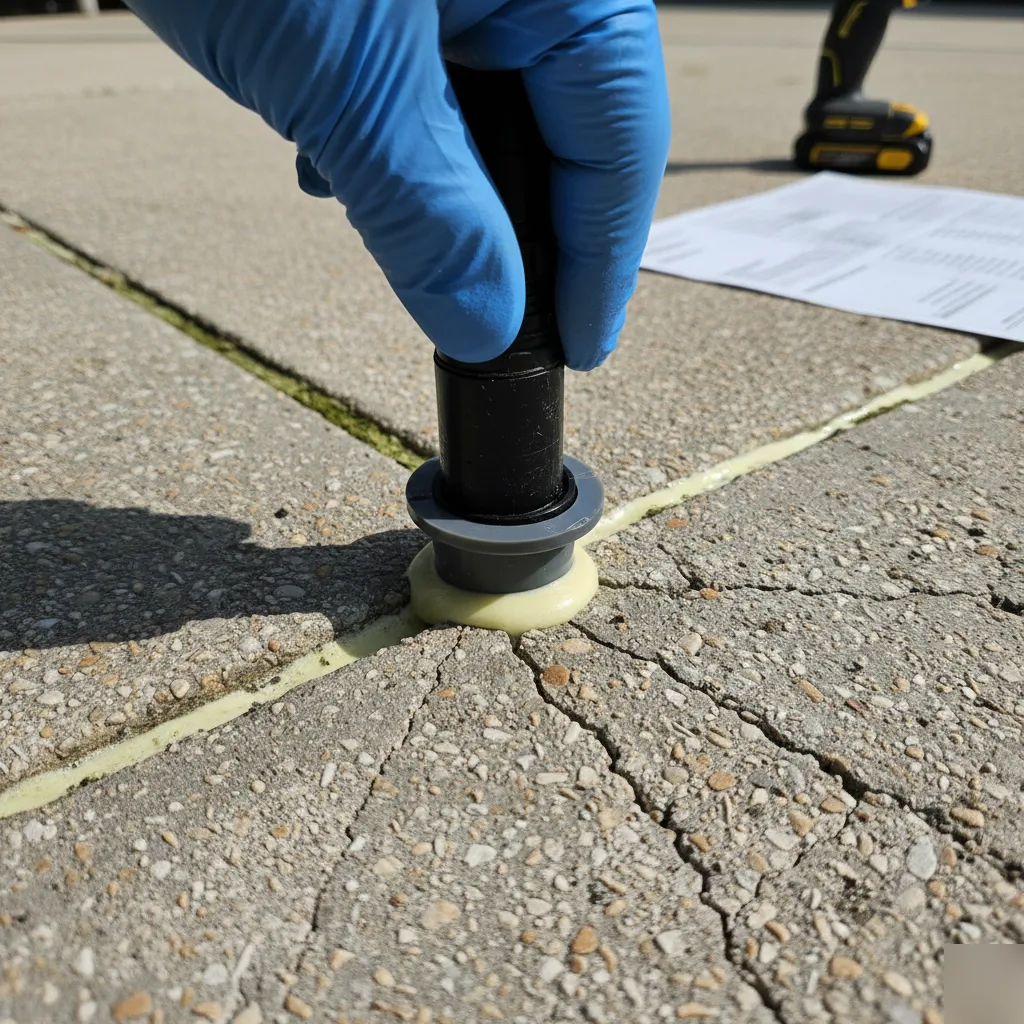
How Polyurethane Foam Pool Deck Leveling Works, One Step at a Time
Most homeowners near Lake Underhill Road haven't had our team level a concrete slab using foam in the backyard. It's faster than you might think, with no need to move machinery onto the landscape.
When our crew shows up to your Azalea Park property, here's exactly what we do:
- Drill small access holes. We use a drill to poke a couple of small (about 5/8-inch) holes in the sunken pool deck slabs. You probably won't even notice them later.
- Insert injection ports. Each hole has a port placed that connects to our foam injection system. Ports are placed at the center and along the center line, depending on how much the sunken concrete has dropped.
- Inject polyurethane foam. The polyurethane foam is delivered through the injection ports in liquid form and expands underneath the slab. It fills every gap and air pocket in the underlying soil — every void that can contribute to sinking — and causes the pool deck to raise up as the foam expands. This part of the process is monitored in real time using a laser level at the surface.
- Monitor and adjust. Too much and the slab overshoots the level position; too little and we don't get it level to the surrounding pool deck. Our experience has taught us exactly how much polyurethane foam is needed, and we monitor the process carefully.
- Patch and clean. As the polyurethane is leveling the pool deck and we confirm we've reached our mark, the injection ports are removed and patched with a concrete patch. You won't likely be able to spot these a week later.
This usually takes us a few hours to complete, rather than multiple days, and you'll be able to enjoy the pool deck the same day.
This is also what makes polyurethane foam different from what's known as mudjacking. Polyurethane foam is lightweight. That is a significant difference, given that traditional mudjacking grouts can exceed 100 pounds per cubic foot. Weight is a critical factor because adding heavy fill material to Florida's sandy soils can actually trigger further settlement down the road. Additionally, the polyurethane foam is water-resistant and hardens in a matter of minutes. This means it will not deteriorate over time when it comes into contact with rain or splash water from a swimming pool. It is not uncommon to find old pool decks in the 32807 area that we have leveled years ago for clients, only for them to settle back to a low spot a few years later. This issue does not occur with our polyurethane foam solution.
Clients report they were expecting a much messier project; in reality, the process is clean, controlled, and complete before lunchtime.
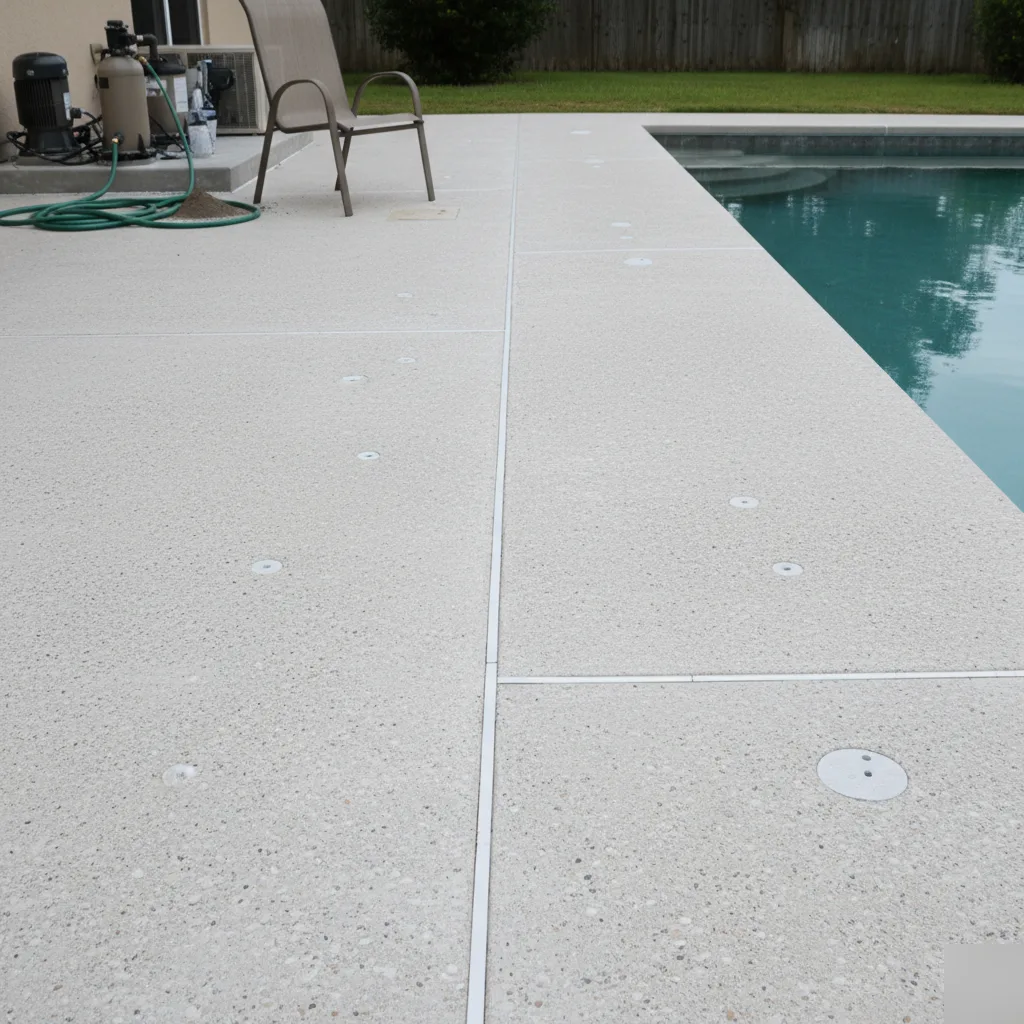
When Pool Deck Movement Indicates a Deeper Issue
On occasion, a shifting swimming pool deck is not just a surface problem, but also an indication that a larger issue exists beneath the slab.
We observe this trend quite frequently in the Azalea Park area. A homeowner notices one section of their pool deck sitting about half an inch lower than the rest. They figure it's normal settling, maybe something that happened over time. But then a few months later, that gap is closer to an inch. The coping stones start pulling away from the pool edge. Water pools in spots that used to drain fine. That's when the call comes in.
In most cases, the situation under the concrete pool deck is one of the following:
- There is washout of the soil due to poor yard drainage or a plumbing leak, or there is a hole or void in the soil underneath the slab.
- There is organic material within the fill soil that has decomposed over time, resulting in a soil cavity beneath the concrete slab.
- There are cycles of wet and dry seasons within Central Florida's sandy soil that cause the ground beneath the pool deck to settle unevenly.
- Tree roots have grown in the area and dislodged the fill soil under the pool deck.
Each of these can lead to a pool deck moving out of alignment, but if a pool deck continues to move over time, that means there are soil voids expanding underneath the concrete slab. Those voids do not repair themselves; in fact, they tend to expand each time the pool overflows, each time water drains across the concrete, or each time the sprinkler system sprays the yard adjacent to the pool deck perimeter. We have observed this particularly frequently around Lake Underhill Road, where the subsoil is sandy. We have pulled up slabs in that area and found six-inch voids that started as hairline gaps.
The risk to the homeowner in this case is more than just a potential trip and fall hazard; in addition to shifting the pool deck, the voids can eventually reach and compromise the structural integrity of the pool itself. This results in cracked bond beams and compromised pool tile. Reviewing pool deck and structural requirements for residential pools makes clear why maintaining a level, properly supported deck surface is not optional — it is a baseline safety standard. If left unaddressed for an extended period of time, the pool will need major repairs that will cost upwards of ten times more than what we would have charged to repair the pool deck initially.
However, if you notice the pool deck moving out of alignment once, you should take note. If the pool deck moves a second time, this is likely a significant indication that there is a soil problem that is continuing to develop. That soil problem will not fix itself, and over time, the soil void can expand underneath the concrete pool deck. When the problem is identified early, we can use polyurethane foam injection to fill those soil voids before they reach the pool itself and cause damage.
See whether leveling is the right fix for your pool deck — book a free estimate.
Get your free estimate