
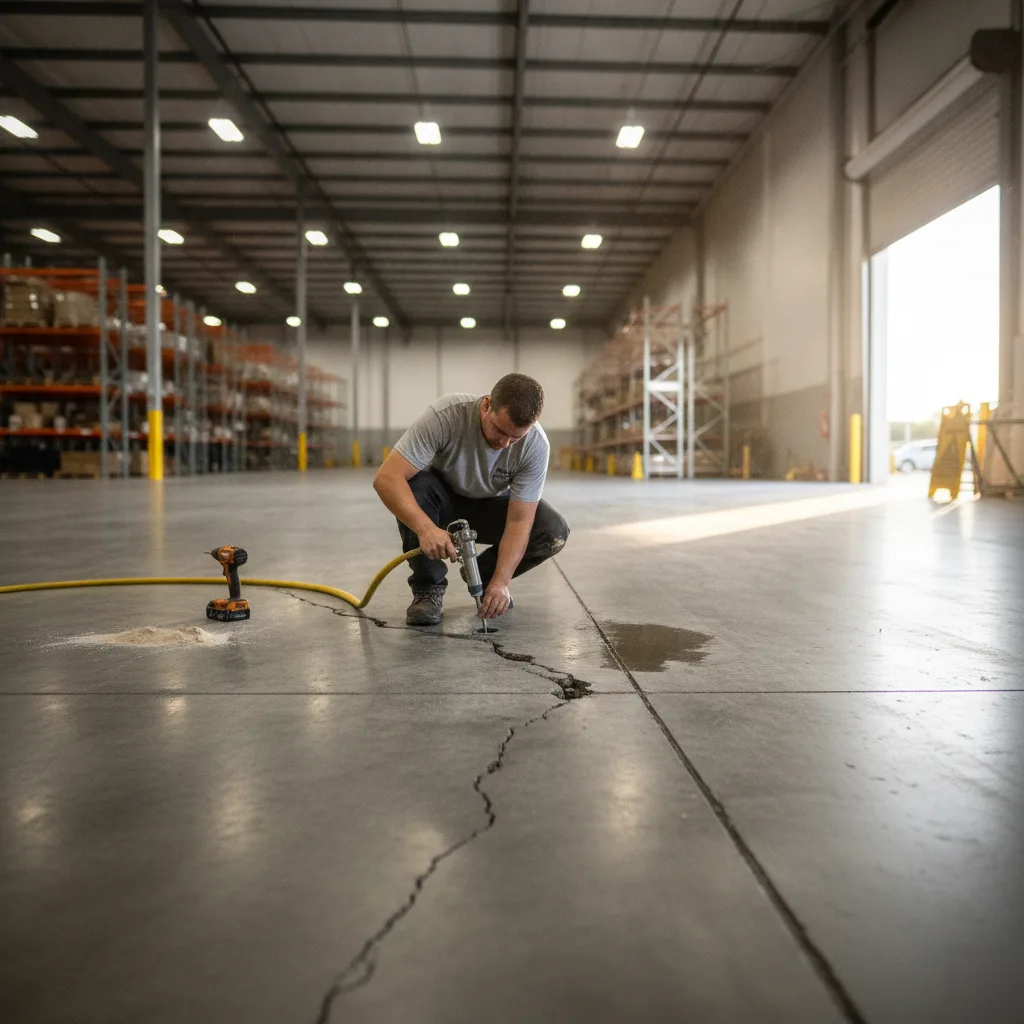
Why Warehouse Floors in Florida's Sandy Soil Sink and Settle
Most people do not think about what lies beneath a warehouse slab. They often just see the floor surface. However, in Azalea Park, FL, the unique soil conditions beneath that floor tell a very specific story about its stability. Homeowners often research cracked foundation solutions for Orange County homes to ensure structural stability.
Central Florida's ground primarily consists of loose sand and various organic materials. This composition means it does not compact with the same density as the clay-heavy soils found in northern regions. When a heavy concrete slab is poured directly onto this type of subgrade, it might appear perfectly stable for several years. Then, often during a single, intense rainy season, the situation changes. Water moves rapidly through sandy soil. As it flows, it can wash away fine particles from directly beneath the slab. This process creates hidden voids. Over time, these voids grow larger. The concrete slab above, now lacking solid support, begins to drop. This settling can sometimes be a subtle quarter inch. Other times, it can be a significant two inches or more in a single, localized spot.
The Factors That Speed Things Up
We observe this pattern consistently in facilities near Lake Underhill Road and along the SR 408 corridor. Warehouses that were originally constructed on fill dirt are particularly susceptible to these issues. Here is what tends to make concrete floors settle at a faster rate in this specific area of Orange County:
- Poor initial soil compaction during the original construction phase, a common issue in many older buildings across the 32807 zip code.
- Consistent, heavy forklift traffic that repeatedly impacts the same travel paths every day.
- Fluctuations in the local water table. These cycles saturate the subgrade with water, then allow it to dry out, contributing to soil movement.
- Undetected broken underground plumbing. This can cause continuous water leakage, leading to soil erosion beneath the slab without anyone realizing the problem.
What frequently catches most warehouse managers off guard is that the damage does not occur suddenly. A floor might show signs of slow settling over a period of five or six years. This might happen before someone notices a dangerous lip between two sections of the slab. Or a critical rack system might begin to lean noticeably because one corner has dropped by half an inch. By the time these obvious signs appear, the voids beneath the concrete can be surprisingly extensive and widespread.
The main reason for this sinking is the constant movement of water through the sandy subgrade. Florida's rainy season often delivers several inches of water in just one afternoon. This significant volume of water must go somewhere. It naturally follows the path of least resistance, often flowing directly under your facility's slab. Additionally, the organic material mixed into our local soil naturally breaks down over an extended period. This decomposition creates further empty space, allowing the concrete to settle even more.
Understanding the specific reasons why your floor has moved helps us determine the most effective repair strategy. For example, a slab that settled due to poor compaction needs a different repair method than one undermined by a leaking pipe. We always conduct a thorough assessment to identify the root cause before we begin any work.
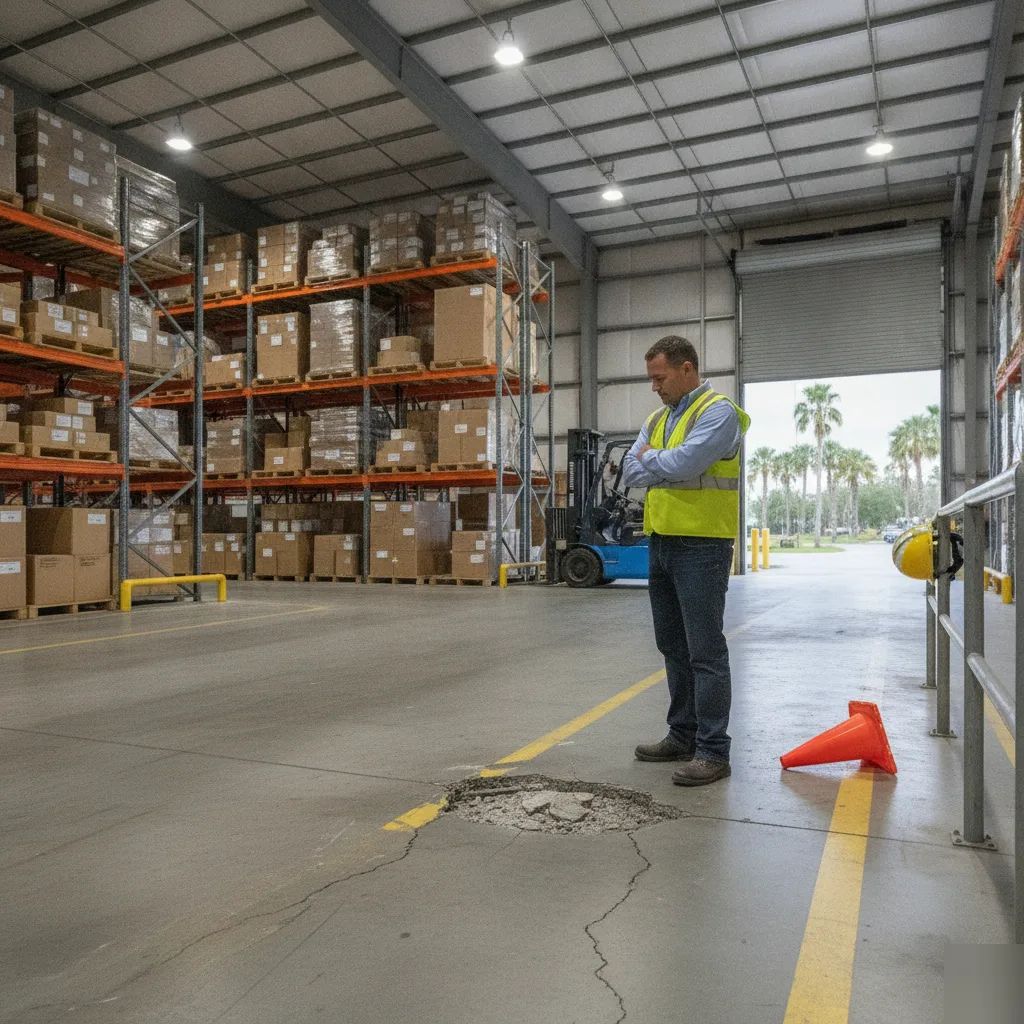
Warning Signs Your Warehouse Floor Has Crossed the Safety Line
Most warehouse managers in Azalea Park typically do not contact us at the very first sign of a crack. Instead, they usually reach out when a forklift begins to wobble noticeably, or when stacks of pallets can no longer be placed flat. By that point, the floor has usually been displaying warning signs for many months.
The indicators of a settling floor are not always dramatic. Sometimes it is a persistent puddle that forms in the exact same spot after every rainfall. Or perhaps a rolling cart that consistently drifts to the left, no matter how carefully it is pushed. We observe these kinds of issues every week in facilities located near Lake Underhill Road, where the sandy Florida soil frequently shifts under the stress of heavy slab loads.
What to Watch For
Here is what we advise every warehouse operator to monitor closely. If you observe even two of these specific indicators, it is a clear sign that a professional assessment is needed:
- Visible cracks in the concrete that are wider than a quarter inch, especially if they appear to be growing longer or developing new branches.
- Uneven joints between distinct slab sections. These can cause forklifts to bump, catch, or experience jarring impacts.
- Standing water that persistently pools in areas that previously drained without issue.
- Racking systems that have visibly shifted out of their vertical alignment or require constant shimming to remain stable.
- Overhead doors or loading dock plates that no longer close perfectly flush with the adjacent floor surface.
That final point about doors and dock plates often catches people off guard. A loading dock door that suddenly cannot seal correctly is not always a problem with the door mechanism itself. It frequently indicates that the concrete slab underneath has settled unevenly.
Here is another observation many people miss. A warehouse floor can appear mostly flat and stable from standing height. However, it might actually be two inches off level across a 50-foot span. You will not detect this subtle slope with your eyes alone. Your equipment, such as forklifts and conveyors, will be the first to show the signs. Forklift tire wear patterns might change unexpectedly. Conveyor belts could start tracking crookedly. Even product stored on shelves for years might begin to fall off due to instability.
According to the American Concrete Institute, any slab deflection beyond acceptable tolerances creates increasing structural stress within the concrete. This means that seemingly small problems can develop into significant issues very quickly under constant, heavy loads.
Are you unsure if what you are observing is serious enough to warrant immediate action? That is a very common concern for property owners in the Azalea Park area. We offer a free estimate specifically so you can receive accurate answers without any sales pressure. A single visit with our laser leveling equipment tells us precisely where your floor stands in Azalea Park's 32807 zip code. It also helps us determine whether warehouse floor leveling is necessary right now or if it can be monitored for a period.
How the Polyurethane Foam Injection Process Works Step by Step
Most warehouse managers in Azalea Park often anticipate a major operational disruption when thinking about floor repair. They picture torn-up concrete, the presence of heavy machinery, and days of complete facility downtime. We work differently.
Polyurethane foam injection is the modern, efficient method we use for slab leveling. The process itself is quite straightforward once you observe it in action. We have successfully completed this type of work on busy loading areas off Semoran Boulevard and at various distribution centers situated near the SR 408 corridor. Every job we undertake follows the same proven and effective sequence.
The Step-by-Step Process
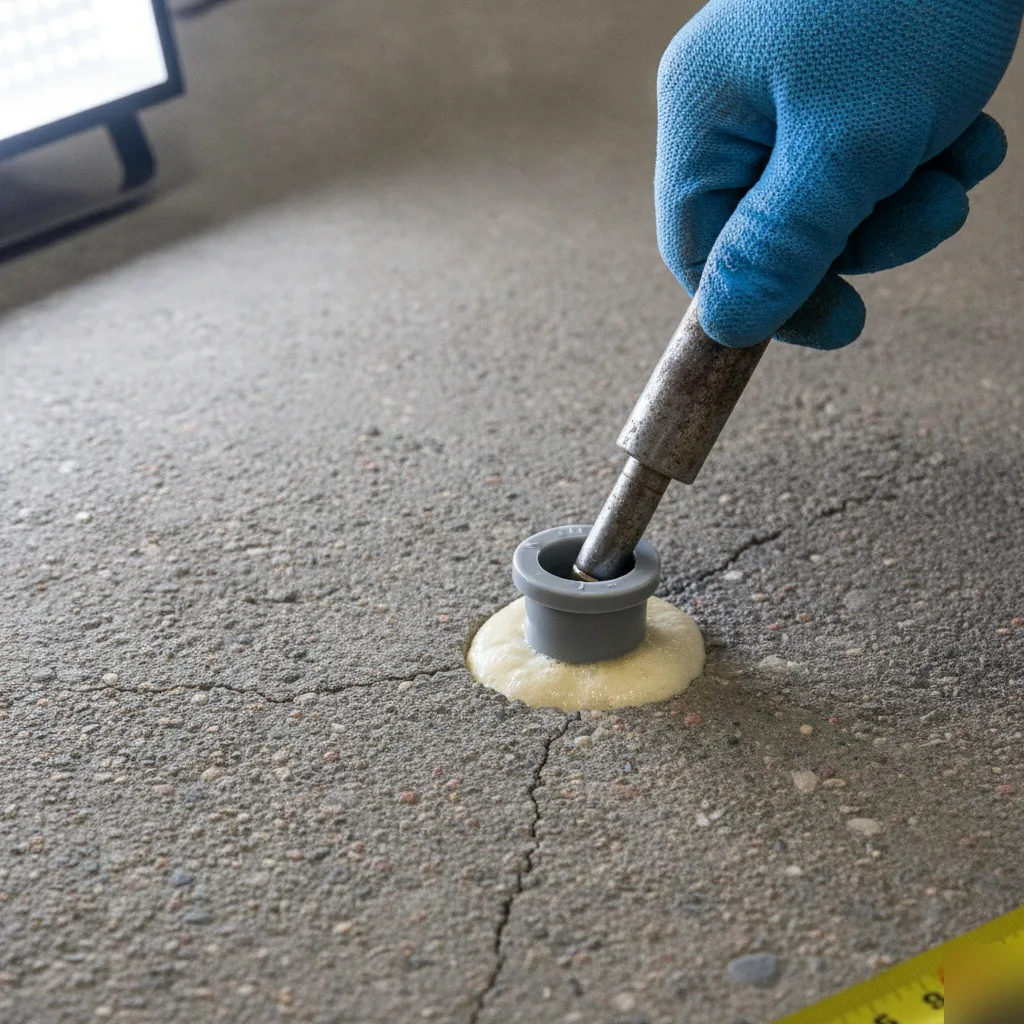
- Drill small injection ports. We carefully bore penny-sized holes through the concrete slab at specific, pre-determined locations. These holes are precise, not random. Each one aligns directly with the identified voids and low spots discovered during our initial inspection.
- Insert the injection gun. A specialized nozzle is then gently inserted into each drilled port. It sits flush with the surface, so the expanding foam reaches the exact depth required beneath the concrete slab.
- Inject the polyurethane foam. The specialized two-part foam begins to expand rapidly, within a matter of seconds, once it is injected beneath the slab. Its first action is to completely fill any existing voids. Following this, it builds controlled pressure, gradually lifting the concrete back to its correct, level position. We continuously monitor the slab's elevation using advanced laser equipment throughout this entire process.
- Check level and adjust. Our experienced crew reads the laser measurements in real time. If a particular section requires even a fraction of an inch more lift, we can add additional foam immediately. This precise approach eliminates any guesswork from the leveling process.
- Patch the ports and clean up. After the leveling is complete, each injection hole is carefully sealed with a concrete patch. Once these patches cure, they will be barely noticeable on your warehouse floor.
The injected foam achieves its full structural strength in approximately 15 minutes. This is not a misprint. Your forklifts and pallet jacks can resume normal operations over the repaired area on the very same day. We often see the surprise and relief on people's faces when they realize how quickly their operations can restart.
Another significant benefit is that the foam is highly moisture-resistant. This means it will not absorb Florida's groundwater or break down over time, unlike some traditional mudjacking grouts. According to the International Concrete Repair Institute, polyurethane foam maintains its structural integrity even when exposed to high-moisture environments. This characteristic is especially important in the 32807 zip code, where the water table is frequently close to the surface.
The entire polyurethane foam injection process typically concludes within a few hours for most warehouse sections. There is no need for jackhammering, and no extended curing delays that could stretch into the following week. Your facility's operation keeps moving forward with minimal interruption.
Do you want to determine if your warehouse floor is a good fit for this efficient approach? We encourage you to give us a call for a free estimate tailored to your property.
Keeping Your Azalea Park Warehouse Running During the Repair
One of the very first questions business owners ask us is whether they will need to completely shut down their operations. The short answer we provide? Almost never.
We have performed floor leveling in many active facilities located all along the busy Semoran Boulevard corridor. It is common to have forklifts operating in aisles just two over from where we are actively working. Our polyurethane foam injection process does not require heavy excavation work or multiple days of concrete cure time. Most areas we treat are ready for foot traffic within 15 minutes of completion. Full load traffic, including heavy machinery, can typically resume within a few hours. That rapid turnaround is not a typo. We frequently observe warehouse managers visibly relax with relief when they hear this key detail.
How We Minimize Disruption
Before we drill a single injection hole, we always take the time to sit down with your operations team. Together, we map out a detailed plan designed to minimize any impact on your daily workflow. Here is what that strategic planning looks like in practice:
- We carefully identify all zones requiring concrete leveling. We then rank these areas by their severity, allowing us to address the most critical spots first.
- We coordinate our work schedule to align with your facility's slower operational windows. This often means working during early mornings, evenings, or even weekends if that accommodates your needs.
- We section off only small, specific work areas using clearly marked cones or barriers. This allows the vast majority of your warehouse floor to remain open for normal traffic flow.
- We inject the foam, achieve the correct level, and quickly move on to the next section. We typically clear each treated zone and make it ready for use within the same working day.
The drill holes we create are approximately the size of a penny. There is no loud jackhammering involved in our process. You will not find concrete trucks blocking your essential loading docks. And, importantly, there is no waiting for a full week for a new concrete slab to cure while your Azalea Park warehouse sits completely idle.
Consider this approach compared to a full tear-out and repour of your warehouse floor. That traditional type of project can force a facility to shut down for several weeks. Such an extended closure can easily cost you more in lost productivity and revenue than the actual repair itself. We have had customers located near the Orlando Executive Airport tell us they postponed addressing leveling issues for years. They simply assumed it meant completely closing their building. Our methods prove that is not the case.
However, here is a point most people do not fully realize. The longer you postpone necessary repairs, the more difficult it becomes to maintain a safe and efficient operation. A half-inch lip in your floor today could easily become a significant two-inch drop next year. When this happens, forklifts begin losing their loads. Workers become more prone to tripping hazards. Racking systems shift further out of plumb, compromising their safety. The true disruption is not the timely repair. It is the cascading problems and safety risks that occur when you choose to skip it.
Do you need assistance figuring out a repair plan that seamlessly fits into your existing schedule? We invite you to give us a call for a personalized discussion.
What Happens After the Work Is Done: Verification and Long-Term Performance
You should never have to simply trust that your warehouse floor is level. You deserve to see concrete proof of the work completed.
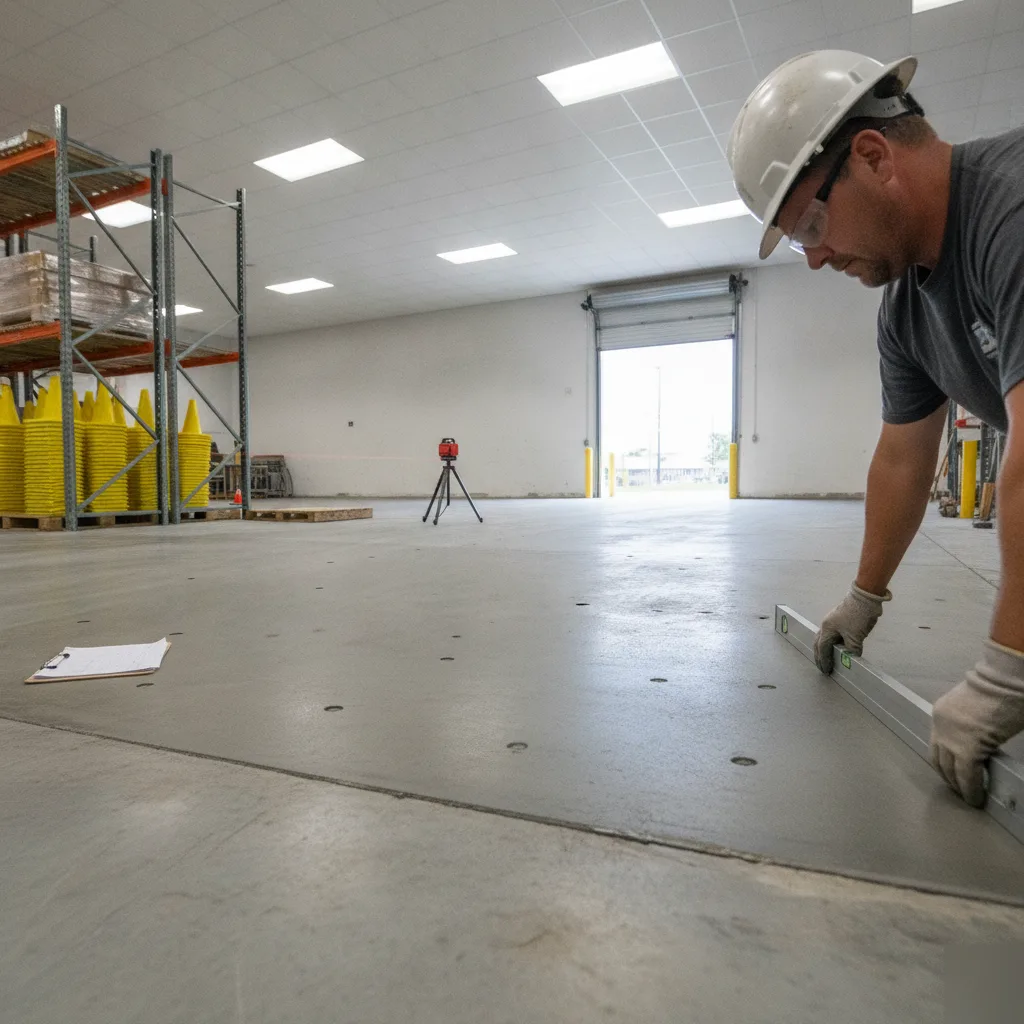
Once we have finished the floor leveling process at your Azalea Park facility, we do not simply pack up our equipment and leave. We provide clear, verifiable proof. We meticulously verify every section we have treated using precise laser levels and straightedge checks across the entire slab surface. If any spot registers outside of the acceptable tolerance, we address it immediately. This means right then, on the same visit. Not later with a follow-up appointment. We fix it right there. We have been performing this type of work for over 25 years, and "close enough" is never sufficient when heavy forklifts are consistently running loaded across that surface every single day.
What Verification Looks Like
Here is a detailed overview of what happens after the polyurethane foam injection has cured and the concrete slab has reached its final, stable position:
- We re-shoot all elevation points. We then directly compare these new measurements to the initial readings taken before our work began.
- We conduct thorough checks on adjacent concrete panels. This helps us identify any remaining issues that could potentially catch the wheels of pallet jacks or other equipment.
- We walk the entire repaired floor area with your operations team. This important step allows you to flag anything that does not feel completely right underfoot.
- We meticulously document all final readings and provide a report to you for your permanent records.
That detailed documentation holds more value than many people initially realize. Warehouse managers operating near the Semoran Boulevard industrial corridor have informed us that this documentation has proven helpful during insurance reviews and critical lease negotiations. Having real, verified numbers on paper carries significant weight in such situations.
Here is the aspect that provides our customers with the greatest long-term confidence. The specialized foam we inject is a closed-cell polyurethane material. This means it will not absorb Florida's naturally high groundwater or degrade over time due to moisture. While the sandy soils common in the 32807 zip code can certainly shift, the cured polyurethane foam maintains its density and structural integrity for many decades. This ensures the level position we achieve stays exactly where we put it.
Most of our Azalea Park clients tell us they effectively forget we were even there within about a week. That is precisely our goal. We aim for no ongoing maintenance headaches and no need for repeat visits to address the same recurring problem. Your racking systems will sit plumb and stable. Your equipment will roll smoothly and predictably. And your floor drains will function exactly as they should.
However, if something ever does change with your foundation, we stand firmly behind our work. We provide a lifetime warranty and offer a free estimate on any future concerns you might have. One simple call will get us back out to your property to take a thorough look.
See whether foam injection is the right fix for your warehouse floor — book a free estimate.
Get your free estimate